Art across the complex
The Florence Duomo is a gallery as much as a cathedral. Its greatest works are spread across three places — inside the cathedral, on and around the Baptistery, and in the Opera del Duomo Museum, where the fragile originals now live. Knowing what is where, and which are originals and which are copies, is half the value of a guided visit.
Inside the cathedral
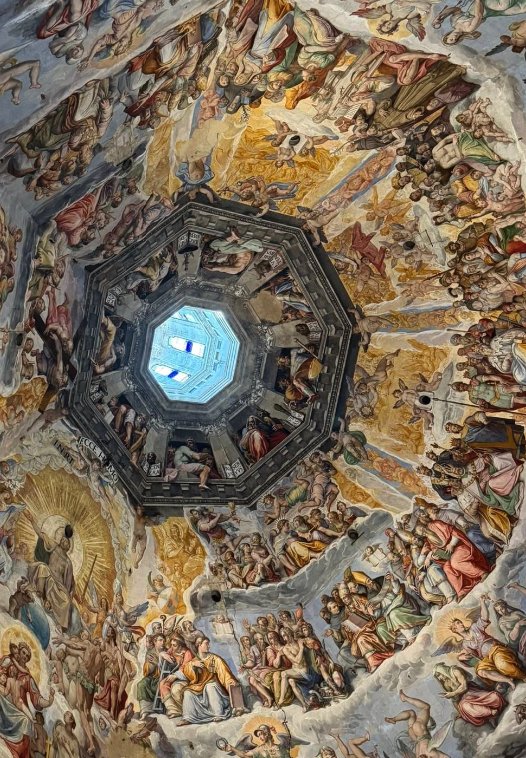
The showpiece is overhead: the interior of Brunelleschi's dome is covered by an immense Last Judgment, begun by Giorgio Vasari in 1568 and finished by Federico Zuccari by 1579. Lower down, the counter-façade carries Paolo Uccello's great painted clock of 1443, still keeping the old Italian hours. On the north wall, two frescoed monuments to mercenary commanders — Uccello's Sir John Hawkwood and Andrea del Castagno's Niccolò da Tolentino — are early triumphs of painted perspective.
On the Baptistery
The Baptistery's fame rests on its bronze doors, above all Lorenzo Ghiberti's east doors, which Michelangelo is said to have called the Gates of Paradise. Their ten gilded panels of Old Testament scenes took Ghiberti and his workshop from 1425 to 1452. The doors on the building today are replicas; inside, the ceiling glitters with a 13th-century gold-ground mosaic of the Last Judgment.
In the Opera del Duomo Museum
The museum holds the treasures too precious or too weathered to leave outside:
- Ghiberti's original Gates of Paradise — the restored gilt-bronze panels, displayed indoors since flood and pollution threatened them.
- Michelangelo's Bandini Pietà — a late, unfinished group the sculptor intended for his own tomb and, in frustration, partly broke.
- Donatello's Penitent Magdalene — a gaunt, harrowing wooden figure carved in the artist's old age.
- The two cantorie — the marble singing galleries carved by Luca della Robbia and Donatello, alive with dancing children and musicians.
- Brunelleschi's wooden model of the dome — the object that helped win him the commission.
Why the originals moved indoors. The devastating 1966 flood of the Arno, together with decades of air pollution, showed that Ghiberti's doors and other outdoor works could not survive in the open. Over the following decades the originals were restored and moved into the museum, and faithful copies took their place on the piazza — so what you photograph outside is usually a replica, and the real thing is a few minutes' walk away.
Stained glass and a brush with murder
Look up into the drum of the dome and you will see round stained-glass windows designed by some of the same names: Ghiberti, Donatello, Paolo Uccello and Andrea del Castagno each contributed a design. Over the two sacristy doors flanking the altar, Luca della Robbia set glazed terracotta lunettes of the Resurrection and the Ascension, and cast the bronze doors of the North Sacristy in his unmistakable blue-and-white style.
Those bronze doors also witnessed one of the darkest moments in Florentine history. During High Mass on 26 April 1478, assassins of the Pazzi conspiracy struck at the Medici brothers: Giuliano was killed at the altar, while Lorenzo the Magnificent fought his way clear and barred himself inside the North Sacristy behind Luca della Robbia's doors until help came. Standing in the cathedral, you are looking at the actual stage of that plot.
Several tours pair the museum with the dome climb, which is the best way to see these works in context — compare the guided Florence Duomo tours, or read how the complex fits together in our guide to the complex.
See the masterpieces with a guide
The museum makes far more sense with someone to explain it — book a tour that includes the Opera del Duomo Museum and the dome climb.
Browse guided tours