Six monuments, one cathedral
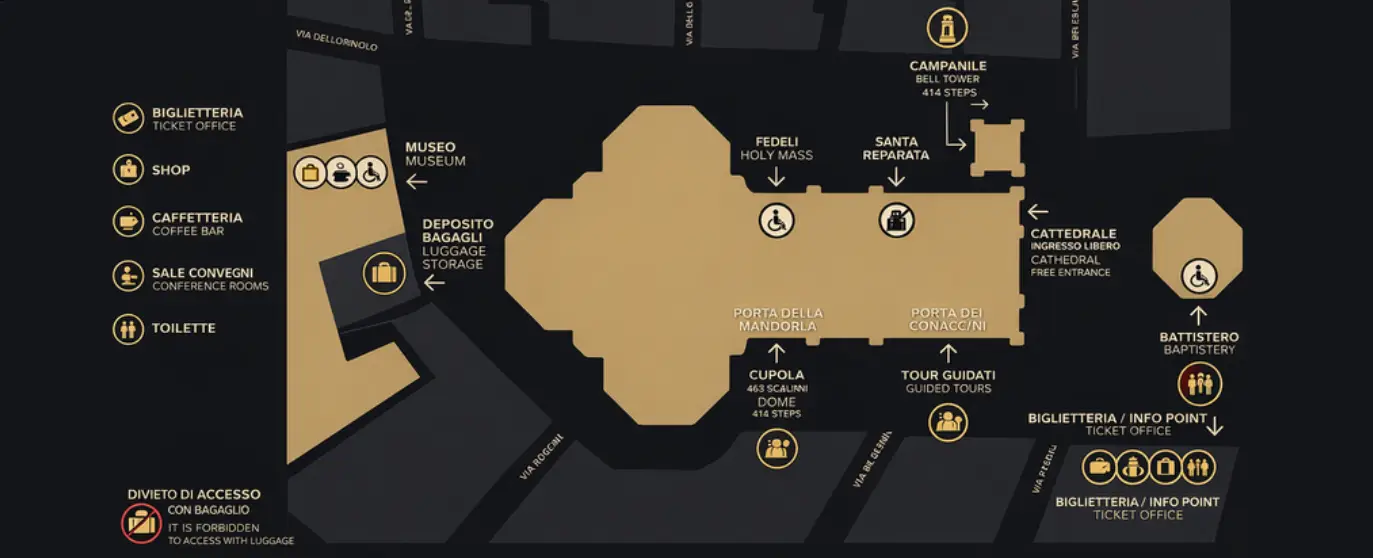
The Florence Duomo is not a single building but a group of monuments gathered around Piazza del Duomo, all belonging to the Cattedrale di Santa Maria del Fiore. Most visitors picture the great red-tiled dome, but the site takes in the cathedral itself, Brunelleschi's dome, Giotto's Bell Tower, the octagonal Baptistery of San Giovanni, the Opera del Duomo Museum, and the crypt of Santa Reparata beneath the nave. A single combination pass ties them together, and a guided tour is the quickest way to see how they fit.
The Cathedral (Santa Maria del Fiore)
The cathedral is the heart of the site and the only part you can enter free of charge. Begun in 1296 to a design by Arnolfo di Cambio, it was built to hold the whole population of medieval Florence, and its scale still surprises inside — a long, sober nave that draws the eye up to the dome at the crossing. Look for Paolo Uccello's painted clock on the counter-façade and the two frescoed monuments to mercenary commanders on the north wall.
Brunelleschi's Dome
Raised by Filippo Brunelleschi between 1420 and 1436, the dome is the largest masonry dome ever built and the reason the cathedral is world-famous. Brunelleschi devised a double shell of brick laid in a self-supporting herringbone pattern, so the whole thing rose without the wooden centering every earlier dome had relied on. Climbing it — 463 steps, no lift — takes you between those two shells, out beneath the Last Judgment frescoes, and onto the highest viewpoint in the city.
Giotto's Bell Tower
The free-standing campanile beside the cathedral was designed by the painter Giotto in 1334 and completed after his death by Andrea Pisano and Francesco Talenti. At just under 85 metres, its 414-step climb is a little gentler than the dome and gives you the one view the cupola cannot: the dome itself, seen head-on across the rooftops.
The Baptistery of San Giovanni
The octagonal Baptistery is the oldest building on the square, and for centuries every Florentine — Dante among them — was baptised here. Its bronze doors include Lorenzo Ghiberti's Gates of Paradise, whose gilded panels are often described as a starting point of the Renaissance. The doors facing the square today are exact replicas; the originals are kept in the museum.
The Opera del Duomo Museum
Across the piazza, the museum is where the complex's most fragile treasures were moved for safekeeping: Ghiberti's original Gates of Paradise, Michelangelo's late Bandini Pietà, Donatello's gaunt wooden Mary Magdalene, and the wooden model Brunelleschi used to argue for his dome. Many visitors rate it the quiet highlight of the whole site.
Santa Reparata
Beneath the cathedral floor lie the excavated remains of Santa Reparata, the earlier church that stood here before Santa Maria del Fiore was raised over it. The crypt also holds Brunelleschi's tomb — a fitting resting place directly under the dome he built.
Which pass covers what. There are no single tickets. The Ghiberti Pass (€15) covers the Baptistery, museum and crypt; the Giotto Pass (€20) adds the bell tower; and the Brunelleschi Pass (€30) is the only one that includes the dome climb. All are valid 72 hours, and only the dome needs a fixed time slot.
For a full breakdown of hours, prices and how the passes work, see our visiting guide, or compare the guided Florence Duomo tours that bundle skip-the-line entry with the climb.
See the whole complex with a guide
Skip the queues and let a licensed local guide connect the dome, the museum and the Baptistery into one story.
Browse guided tours