A cathedral for a rising city
By the end of the 13th century Florence was one of the richest cities in Europe, and its old cathedral of Santa Reparata looked shabby beside those of rival Pisa and Siena. In 1296 the city commissioned a vast replacement, Santa Maria del Fiore — the Cathedral of Saint Mary of the Flower — from the architect and sculptor Arnolfo di Cambio. He laid out the enormous nave and began the marble walls before work slowed after his death.
Giotto and the bell tower
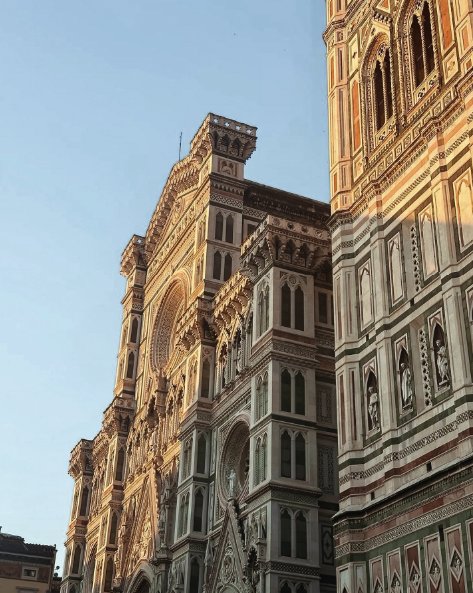
In 1334 the painter Giotto di Bondone was put in charge of the cathedral works and turned first to the campanile that still carries his name. He died only three years later, and the bell tower was carried on by the sculptor Andrea Pisano and completed by Francesco Talenti around 1359. Talenti and Neri di Fioravanti also enlarged the cathedral's plan, setting the huge span that the crossing would one day have to cover.
The dome no one knew how to build
That span was the problem. The design called for a dome wider than any raised since antiquity, and for decades no one knew how to build it without a forest of wooden scaffolding that Florence could not supply. In 1418 the wool merchants' guild held a competition; the goldsmith Filippo Brunelleschi won it, reputedly by challenging his rivals to make an egg stand on end. From 1420 he raised the cupola as a double shell of brick laid in a herringbone pattern that supported itself as it rose — an engineering solution still studied today.
Consecration and the lantern
The dome was closed at the top in 1436 and the cathedral consecrated that year by Pope Eugenius IV. Brunelleschi went on to design the marble lantern that crowns it, though he died in 1446 before it was finished; it was completed around 1461, and he was buried in the crypt directly beneath his masterpiece. Between 1568 and 1579 Giorgio Vasari and Federico Zuccari covered the dome's interior with an enormous fresco of the Last Judgment.
The façade that came and went
For all its grandeur, the cathedral spent centuries without a finished front. Arnolfo's original medieval façade was left incomplete and then dismantled in 1587. The building stood with a bare brick front until the 19th century, when Emilio De Fabris designed the neo-Gothic façade of white Carrara, green Prato and pink Maremma marble that you see today, built between 1876 and 1887.
Did you know? Michelangelo's David was originally carved for one of the cathedral's buttresses, high on the roofline. When the finished statue proved too magnificent to hide up there, the city placed it in the Piazza della Signoria instead — and the Duomo's connection to the Renaissance's greatest sculptor was sealed.
The Duomo today
The cathedral is still the seat of the Archbishop of Florence and an active place of worship, while the Opera di Santa Maria del Fiore — the workshop founded in 1296 to build it — still maintains the whole complex. After the 1966 flood of the Arno damaged Ghiberti's Baptistery doors, the originals were moved indoors, and the site today balances a living church with one of the most visited monument groups in Italy.
To see where this history actually happened, compare the guided Florence Duomo tours that include the dome climb, or read about the art and treasures kept across the complex.
Walk through 700 years of history
A licensed guide brings the cathedral, the dome and the museum to life — with skip-the-line entry so you spend the time listening, not queuing.
Browse guided tours